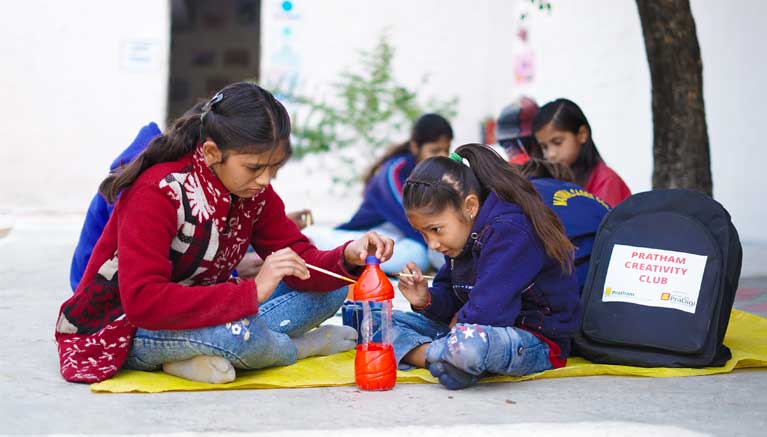
In an ever-changing world, beyond academics, core skills such as problem-solving, creativity, communication, and collaboration are vital for children to thrive. These skills go beyond traditional academic knowledge and prepare children to adapt, innovate, and succeed in the real world.
India’s National Education Policy (NEP) 2020 also encourages experiential learning, shifting the focus from rote learning to hands-on, practical experiences, including project-based, art-integrated, and sports-integrated activities to enhance creativity.
Stemming from the need for choice-based learning in an open environment, the Creativity Club program was launched where every child can imagine, create, and innovate.
What is Pratham Creativity Club?
Pratham began its digital initiatives in 2015 with the Hybrid Learning Program, which was an experiment to understand the implications of placing technology (mainly tablets) in the hands of children aged 10-14. The program also focused on encouraging community ownership of children's learning outcomes by extending education beyond schools.
Building on the insights of this program, an Open Learning Model was developed that emphasised the integration of three key components:
Social structure: Recognising that children learn from various sources beyond schools, including their communities, peers, and digital networks.
Digital infrastructure: Ensuring access to technology, either by providing devices or leveraging existing resources, to facilitate learning.
Learning content: Offering freely available, high-quality learning resources, allowing children to acquire new skills at their own pace and based on their interests. To support this, the centre built Pratham Open School, an online open repository of educational resources.
The Creativity Club Program emerged from the lessons of the Hybrid Learning Program. It is designed to engage children and youth in diverse domains, such as STEM (Science, Technology, Engineering, and Mathematics), arts, environment, and sports.
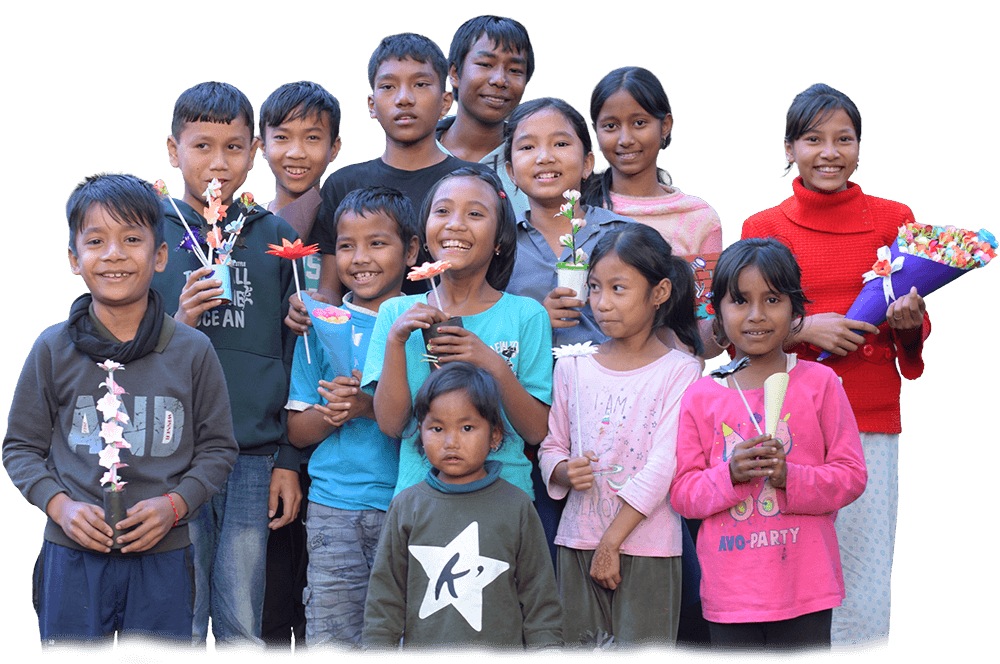
In 2025–26, the program reached over 2 lakh children and 12,000 youth in more than 12,000 villages and 3,200 schools across 17 states.
How it works
The 4Ex Approach
The program is structured around the 'Ex-framework':

Expose
learning by observing

Explore
learning by engaging

Experiment
learning by doing

Exchange
learning by sharing
A Creativity Club is a group of children (10–15) that meets regularly, anchored by young volunteers or teachers referred to as Creativity Champions. Implementation follows an All–Some-Few approach:
ALL
Creativity Champion
Youth volunteer in a community or teacher in a school.
Creativity Clubs
Champion anchors a space for children to meet in groups once every week.
Building Projects
Creative challenges around STEM, arts, sports, environment, and computational thinking are shared with champions. Children attempt challenges of their choice and create projects.
Some-Few
Creativity Fairs
Based on participation and projects submitted, selected children are invited for a day-long workshop that culminates in a ‘fair’.
Creativity Camps
Children who show deeper interest in a particular domain are offered intensive domain-specific camps.
Age group covered
Children (10-14 years): Children access creative content, engage with each other in groups, and participate in Creativity Club activities. These activities offer them opportunities to apply their cognitive and physical skills across distinct domains.
Youth (14-18+ years): Youth volunteers, while pursuing their own learning goals (through remote mentorship, digital learning courses, and workshops/camps), run Creativity Clubs with children and other members in their community.
Digital platforms are used to support communication and sharing across schools and communities, helping children document their work and facilitators stay connected.
Three core outcomes
Creative Learning Spaces and Community Ownership: Fostering vibrant creative learning spaces within communities and schools, led and championed by youth volunteers, teachers, and local stakeholders.
Exposure and Aspiration Shift: Providing children with opportunities that broaden their worldview and influence aspirations and long-term achievements.
Core Skill Development: Enabling children to develop creativity, critical thinking, and problem-solving abilities through a continuous cycle of hands-on, project-based learning.