
A swimming coach guarantees he can teach swimming in 4 days and invites interested individuals to join a course. 50 people turn up, with lots of enthusiasm, to the training venue — a large hall with a laptop-projector, tables and chairs, and a whiteboard with markers and dusters.
The trainer starts with introductions and icebreakers to “warm" everyone up. He then shows a presentation with the key benefits of swimming, followed by the principles of hydrodynamics and swimming. To make the session “engaging" and “interactive", he keeps asking if everyone has understood and everyone nods. Similar sessions on breathing techniques, hand and leg movements and swimming styles continue for the next two days.
The final day is reserved for “practice". Participants are asked to stand up and demonstrate the freestyle arm movement. The room fills with rotating arms and earnest expressions. The trainer nods approvingly. With the training now over, everyone receives their certificates and leaves.
Sounds absurd? Indeed, all of us would be surprised out of our wits if we ever encountered such a coach or course. And yet, replace the word “swimming" by “teaching", with appropriate replacements for swimming specifics, and what we have is a relatively accurate — albeit discomforting — representation of the reality of teacher training in India.
Teaching, like swimming, is a skill that requires sustained practice. What distinguishes it from swimming is that unlike water, which obeys the laws of physics, children do not. How they engage, respond, and learn varies — across children, across days, across contexts. The case for practice and ongoing guidance in real classroom settings is even stronger.
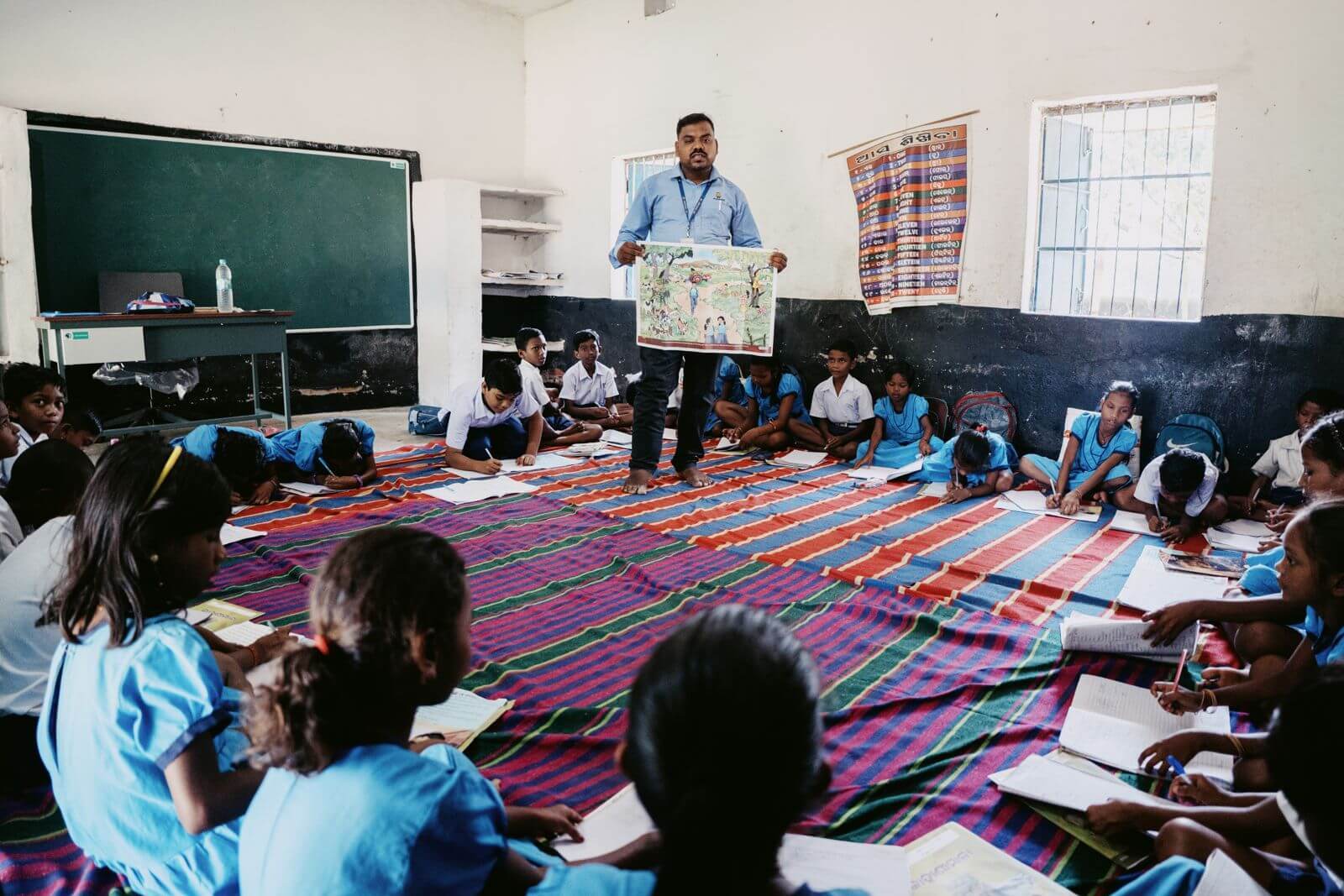
I vividly remember my first brush with teaching children in a government school. The teacher was away attending to administrative requirements, and I enthusiastically stepped in to teach arithmetic. There were more than 50 children, of different ages, of different grades. Those in front could follow; several at the back could not. Some listened attentively, some stared blankly, some were busy distracting those who were trying to focus. In twenty minutes, I was exhausted and humbled by how ill-equipped I was to handle a real classroom. Those twenty minutes gave me a glimpse of what teachers face every single day – an appreciation that has only deepened over the years as I spent more time in classrooms.
Effective and tested pedagogy is important, much like swimming techniques are. But alone they rarely suffice. Pratham developed the Teaching at the Right Level approach that uses activity-based targeted instructions to help children acquire foundational skills. To understand how to scale this within government school systems, we undertook a series of randomised controlled trials across four states with J-PAL and researchers from MIT. The lesson was sobering: in Bihar and Uttarakhand, teachers received well-designed training and Pratham support, yet the approach was not adopted in classrooms. It was only when teachers received ongoing mentoring and support from trained resource persons that meaningful learning gains followed. A comprehensive meta-analysis of teacher coaching studies by Kraft, Blazar, and Hogan found the same — on-the-job instructional coaching produced effects on teaching practice substantially larger than training alone.
Knowing about a pedagogy is only the first rung on the ladder of behaviour change and the one that training focuses on. A teacher must also understand why it matters, have the confidence to try it, and develop the judgement to adapt it to real classrooms, to children’s needs and responses. Moving up the ladder requires consistent reinforcement from senior leaders and on-the-job mentoring from someone who understands, listens, and works with the teacher as a partner. This is what differentiates mentoring from monitoring. Monitoring focuses on whether a behaviour is being followed; mentoring delves deeper into why it is not being adopted, the barriers the teacher faces, and how she can progress. When a mentor visits, observes, and demonstrates alongside a teacher, they signal something powerful: what you do matters, and you are not alone in it. When no one visits classrooms, the signal teachers receive is that what matters is records, files, and infrastructure — not classroom practices.
Just as effective swimming coaches are those who have themselves endured the struggle in water — who know what it feels like to have the breathing out of sync, to not find the right rhythm and form, and then to find it — effective academic mentors are those who have tried the technique in a real classroom, struggled with it, learnt to adapt it, seen it work, and through that experience developed the belief and confidence to guide someone else. We call such mentors “leaders of practice”. They practice before they preach.
Recently we interacted with several government resource persons in Karnataka who had conducted practice classes before training and supporting teachers. As they described how those practice classes shaped their own beliefs about the need for targeted, group-based differentiated instruction and refined their skills planning and implementing activities around children’s learning needs, the conviction in their voices was unmissable. That grounded confidence — which translates into meaningful, contextualised guidance to teachers — cannot be trained in a workshop. It has to be earned in a classroom, with children, over time. The path to becoming a leader of practice must itself be rooted in practice.
Academic mentoring, in itself, is not a novel idea. India’s school system has had resource cadres at block and cluster levels for precisely this purpose. But over the years these cadres have either been dissolved or used primarily for monitoring compliance and collecting data, prioritising “system” demands at the expense of teachers and children. This is not accidental. Administrative demands are immediate and visible; practice change in classrooms is slower and harder to measure. When their work is reduced to the number of visits completed and data submitted, resource persons are discouraged from spending meaningful time in classrooms. The message these metrics send is that their job is to complete tasks and not worry about classroom practices.
These norms of what matters are most immediately visible in monthly review meetings at the cluster and block level. The meetings focus on visits made, tasks done and data collected, rather than what was done in these visits, what was observed, how teachers were supported and whether it worked. Discussions crowd out decisions. These meetings are less “review” meetings and more “record keeping” meetings. Structuring the meetings on inquiry, learning, decisions and follow up would gradually but decisively shape how resource persons see themselves and what they do: not as mere data collectors and messengers, but as practitioners accountable to the teachers and children they serve.
The resource persons visiting schools today can become the leaders of practice shaping classroom practices tomorrow. This requires resource persons to practice and master the very pedagogies they are expected to mentor and the system to singularly focus on what they actually do inside classrooms and how they mentor – not monitor – teachers. So that when the next administrative emergency arises, someone in the system has both the standing and the courage to say: not these people, they are our leaders of practice.
Without such leaders of practice, the best-designed reforms can struggle to change what happens inside classrooms. ASER 2024 found that under the NIPUN Mission, most schools had received FLN directions, trained teachers, and teaching-learning materials. Detailed observations in a smaller subset of schools further revealed that teachers had internalised the importance of foundational learning. Yet classroom practices remained largely unchanged: the chalk-and-duster approach persisted. Awareness was there, intent was there, effort was there. Practice was not. The Teaching Learning Practices Survey 2025 by the Language and Learning Foundation points to the same conclusion. The challenge is no longer convincing teachers what to do. It is helping them learn how to do it consistently in real classrooms. As the Ministry of Education deliberates the next version of the NIPUN Mission, leaders of practice should be at the centre of that strategy for strengthening classroom practice.
Training can build awareness of what teachers should do. Monitoring can tell us whether they are doing it. But neither provides the real-time guidance a teacher needs when she tries to shed old habits and implement new practices in her classroom. Just as a swimmer needs a coach who has endured the journey of becoming a good swimmer, who can relate to her struggles, and who stands by her until she gets it right, our teachers need leaders of practice who observe them, support them, and guide them, with the conviction: I have been where you are, and here is how we move forward together. With the learning outcomes of an entire generation resting on their shoulders, our teachers deserve no less. Our children can afford no less.